Jackery HomePower 3600 Plus Review: Whole-Home Backup Power

Affiliate Disclosure: As an Amazon Associate, we earn from qualifying purchases. This post contains affiliate links, and we may earn a commission at no extra cost to you. All prices and discounts mentioned are the Amazon Reference Price as of writing and may change at any time.
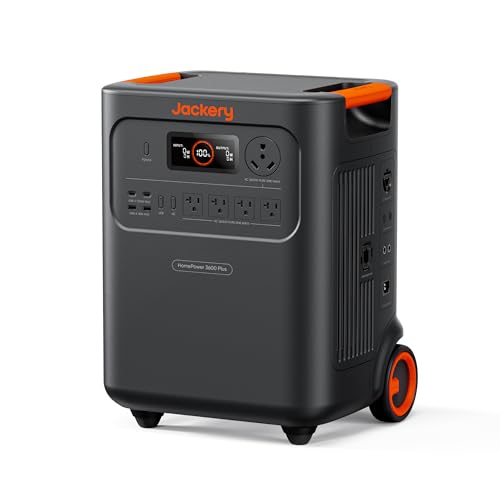
Let’s be honest about what a power outage actually costs. The fridge full of groceries. The sump pump during the storm that caused the outage. The Wi-Fi, the phones, the well pump if you’re rural. A $100 gas generator from the hardware store can cover some of it — if you have a place to run it, fuel stored, and the patience to maintain a small engine that sat unused for two years.
The Jackery HomePower 3600 Plus takes a different approach: a 3,584Wh LiFePO₄ home backup power station with 3,600W of pure sine wave AC output, indoor-safe and silent at around 30dB, that rolls where you need it on built-in wheels. No fuel, no fumes, no pull cord. At $1709.00 (Amazon Reference Price, as of writing), it sits in the serious-backup tier — this review covers whether it earns that price.
Jackery HomePower 3600 Plus: Quick Specs First
| Feature | Jackery HomePower 3600 Plus |
|---|---|
| Capacity | 3,584Wh LiFePO₄ (expandable to 21.5kWh) |
| AC Output | 3,600W pure sine wave (7,200W surge), 4× 120V outlets + 30A RV outlet |
| Solar Input | Up to 1,000W (dual DC ports) |
| AC Recharge | Up to 1,800W — full charge in about 2.5 hours |
| Battery Lifespan | EV-grade LFP, ~6,000 cycles to 70% capacity |
| Weight | ~77 lbs, wheels + telescoping handle + side grab handles |
| Smart | Jackery app (Wi-Fi/Bluetooth) monitoring |
| Price (Amazon Reference Price, as of writing) | $1709.00 |
Whole-Home Backup Power: What 3,600W Actually Runs
Wattage numbers are abstract until you map them onto your actual house. Here’s what 3,600W of continuous pure-sine output covers during an outage:
- Refrigerator + freezer (cycling) — food safety for days
- Sump pump — the appliance you most want running during the very storm that knocked power out
- Wi-Fi router, phones, laptops — staying informed and working
- Portable AC unit or space heater — the single biggest comfort load
- Microwave, coffee maker — the small comforts that make an outage bearable
- Medical devices and CPAP — the reason many people buy in this tier at all
Independent testing confirmed the unit handles surges well above its rated continuous output — real compressor-start surges in the ~5,000W range trip nothing. Independent testing measured inverter efficiency around 89%, in line with the best in classthesolarlab.com. The Jackery app estimates 15 hours to 9 days of runtime on essentials depending on load — and to the brand’s credit, their online runtime calculator factors in real efficiency losses, which most competitors don’tthesolarlab.com.
Honest note: “whole-home backup” here means essential circuits, not running your entire house including central HVAC and electric water heater simultaneously. That’s true of every unit in this price class. For 240V heavy loads, see the expansion section below.
Jackery Explorer 2000 Pro vs HomePower 3600 Plus: Which Jackery Is Right?
Jackery’s two lines serve different jobs, and the naming doesn’t make it obvious. Many buyers arrive comparing this unit against the popular jackery explorer 2000 pro, so here’s the honest breakdown:
- Explorer 2000 Pro (2,160Wh / 2,200W): the camping-and-tailgating champion. Lighter, cheaper, easier to toss in a trunk. Ideal for trips and short outages.
- HomePower 3600 Plus (3,584Wh / 3,600W): built for the house. Roughly 66% more capacity, 60%+ more output, a 30A RV outlet, expansion battery support, and 240V capability — features the Explorer line doesn’t offer.
The rule of thumb: if your primary use is the trunk of a car, the Explorer line fits. If your primary use is “the power is out and I want my house to keep working,” the HomePower line is the one designed for it — and the 3600 Plus is its flagship.
Jackery Expansion Battery: Scaling to 21.5kWh
The headline feature of the HomePower line is modularity. The 3600 Plus alone is 3,584Wh; stack up to six Jackery Battery Pack 3600 expansion batteries and total storage reaches 21.5kWh — enough that independent testing measured roughly 9–10 days of refrigerator-only runtimethesolarlab.com.
The scaling path:
- Start: the base unit — 3,584Wh covers essentials for 1–2 days
- Add one or two expansions: multi-day outage coverage for a full household
- Full 6-pack expansion: week-plus autonomy, or daily-cycle solar living
There’s also a 240V Hub accessory that links two HomePower 3600 Plus units into a split-phase 240V output — which unlocks well pumps, dryers, and partial home-panel integration. That’s the feature that separates this from portable-grade power stations and justifies the “HomePower” name.
And the battery chemistry matters for the long game: LiFePO₄ cells rated for roughly 6,000 cycles means a decade-plus of regular use — no gas, no oil changes, no carburetor cleaning after a year in the garage.
Solar Generator Charging: Three Ways to Refill
As a jackery solar generator setup, the 3600 Plus refills three ways:
- Solar: up to 1,000W input across dual DC ports — roughly a 4-hour full charge from a 1,000W panel array in clear conditionsthesolarlab.com. That 1,000W ceiling is the one spec weakness worth flagging (rivals like EcoFlow DELTA Pro accept 1,600W)thesolarlab.com. For most users it’s plenty; for those with big panel arrays, it’s the honest trade-off.
- Wall outlet: up to 1,800W AC input — a full charge in about 2.5 hours, which is fast for this capacity classthesolarlab.com.
- Car/generator input: a third fallback for extended grid-down scenarios.
The mobility story is also genuinely good: at ~77 lbs with rubber wheels, a suitcase-style telescoping handle, and side grab handles, this is the smallest and lightest 3.6kWh-class unit on the marketthesolarlab.com. You can roll it from garage to kitchen to RV without a second person.
Honest drawbacks from independent testing, worth knowing before buying: no built-in LED light (an odd omission for an emergency unit), the telescoping handle doesn’t always lock at full extension, and idle draw of ~34W is higher than some rivals — meaning don’t leave it plugged in doing nothing for weeks on endthesolarlab.com.
Who Should Buy the Jackery HomePower 3600 Plus?
Grab it if you:
- Live somewhere with real outage risk — storms, grid strain, rural utilities
- Have a sump pump, well pump, or medical devices that must keep running
- Want indoor-safe, silent backup (no exhaust, no fuel storage)
- Own an RV and want one unit that does home backup + travel duty via the 30A outlet
- Plan to scale capacity over time with expansion batteries
Skip it if you:
- Need 240V for central HVAC out of the box (requires two units + the Hub)
- Have a large existing solar array above 1,000W and want to use all of it
- Want maximum capacity per dollar over portability (heavier, cheaper-per-Wh rivals exist)
Pros & Cons at a Glance
✅ Pros
|
❌ Cons
|
Final Verdict: Is the Jackery HomePower 3600 Plus Worth It?
At $1709.00 (Amazon Reference Price as of writing), the HomePower 3600 Plus earns its price for the buyer it’s aimed at: someone who wants silent, indoor-safe, expandable home backup without installing a standby generator. It’s the most balanced 3.6kWh-class unit between portability, output, and expandability that independent testing has measuredthesolarlab.com.
No stress, no fuel cans, no yanking a pull cord in the rain. Charge it, wheel it where you want it, and let the next outage find you ready. For RV owners and homeowners who want one system that does both, this is the sweet spot in Jackery’s lineup.
Get the Jackery HomePower 3600 Plus on Amazon →
FAQ
Q: How long will the HomePower 3600 Plus run a refrigerator?
A: On the base 3,584Wh unit, expect roughly 1.5–2 days of refrigerator cycling. With full expansion to 21.5kWh, independent testing measured around 9–10 days of fridge-only runtime. Actual runtime depends on the fridge’s efficiency and ambient temperature.
Q: Can it power a well pump or dryer?
A: Yes — but 240V appliances require connecting two HomePower 3600 Plus units together with the optional 240V Hub, which produces split-phase 240V output. A single unit covers standard 120V household loads.
Q: Which solar panels are compatible?
A: The unit accepts up to 1,000W of solar input via its dual DC ports. Jackery’s own SolarSaga panels plug in directly; compatible third-party panels with the right voltage range and connectors also work. Solar charging from a 1,000W array takes roughly 4 hours in clear conditions.
Q: Is it safe to use indoors?
A: Yes — it’s a battery system with no exhaust, so it can run indoors, in a garage, or overnight near sleeping areas. This is the fundamental safety difference from gas generators, which must stay outdoors.
Q: How long does the battery last over years of use?
A: The LiFePO₄ chemistry is rated for roughly 6,000 charge cycles before dropping to 70% capacity — enough for a decade or more of regular use, and the unit carries a 5-year warranty.





![Fabric Foldable Storage Boxes [4-Pack] Large Collapsible...](https://spacesavergear.com/wp-content/uploads/tu/d39.jpg)